

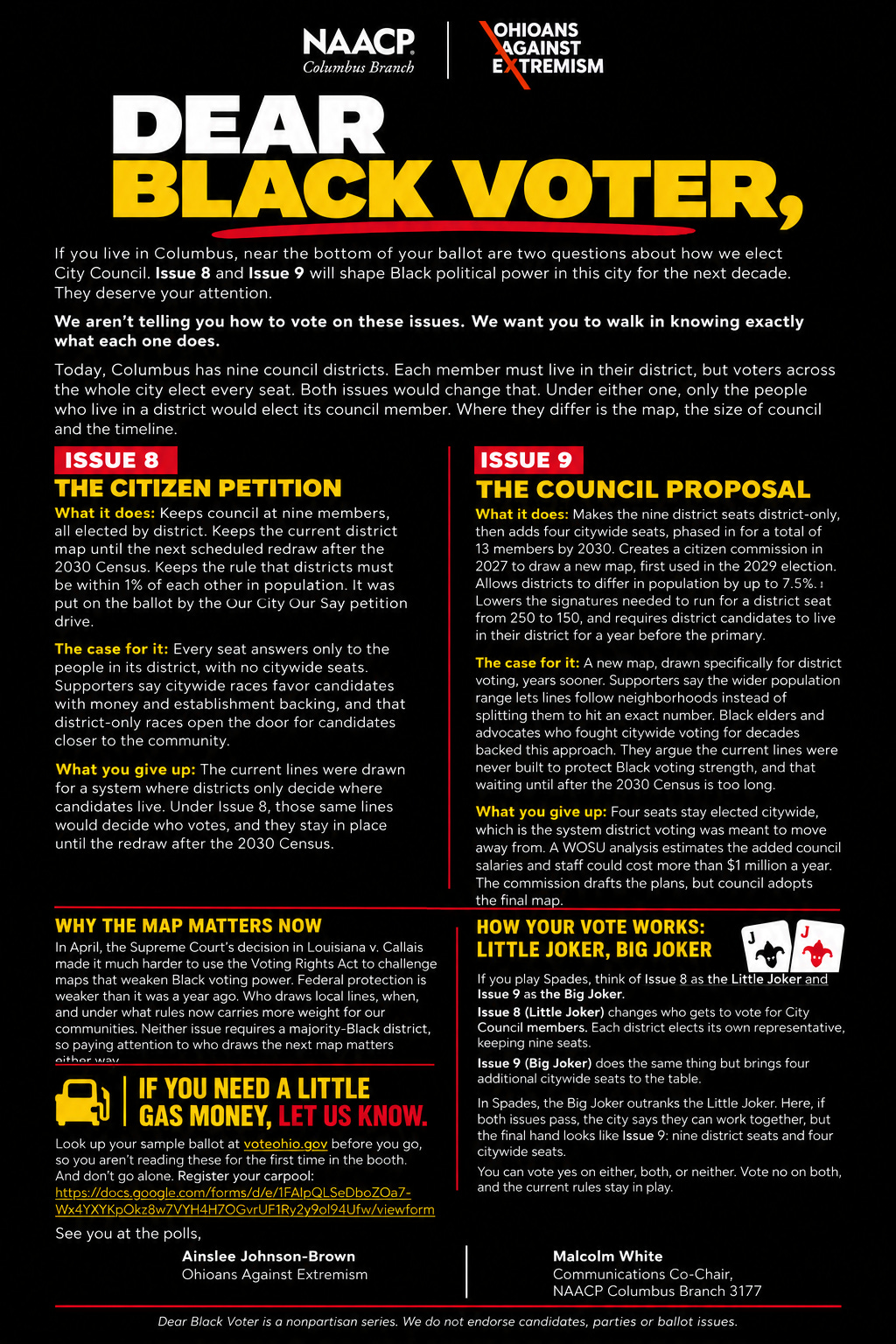
Dear Black Voter,
If you live in Columbus, near the bottom of your ballot are two questions about how we elect City Council. Issue 8 and Issue 9 will shape Black political power in this city for the next decade. They deserve your attention.
We aren’t telling you how to vote on these issues. We want you to walk in knowing exactly what each one does.
Today, Columbus has nine council districts. Each member must live in their district, but voters across the whole city elect every seat. Both issues would change that. Under either one, only the people who live in a district would elect its council member. Where they differ is the map, the size of council and the timeline.
Issue 8, the citizen petition
What it does: Keeps council at nine members, all elected by district. Keeps the current district map until the next scheduled redraw after the 2030 Census. Keeps the rule that districts must be within 1% of each other in population. It was put on the ballot by the Our City Our Say petition drive.
The case for it: Every seat answers only to the people in its district, with no citywide seats. Supporters say citywide races favor candidates with money and establishment backing, and that district-only races open the door for candidates closer to the community.
What you give up: The current lines were drawn for a system where districts only decide where candidates live. Under Issue 8, those same lines would decide who votes, and they stay in place until the redraw after the 2030 Census.
Issue 9, the council proposal
What it does: Makes the nine district seats district-only, then adds four citywide seats, phased in for a total of 13 members by 2030. Creates a citizen commission in 2027 to draw a new map, first used in the 2029 election. Allows districts to differ in population by up to 7.5%. Lowers the signatures needed to run for a district seat from 250 to 150, and requires district candidates to live in their district for a year before the primary.
The case for it: A new map, drawn specifically for district voting, years sooner. Supporters say the wider population range lets lines follow neighborhoods instead of splitting them to hit an exact number. Black elders and advocates who fought citywide voting for decades backed this approach. They argue the current lines were never built to protect Black voting strength, and that waiting until after the 2030 Census is too long.
What you give up: Four seats stay elected citywide, which is the system district voting was meant to move away from. A WOSU analysis estimates the added council salaries and staff could cost more than $1 million a year. The commission drafts the plans, but council adopts the final map.
Why the map matters now
In April, the Supreme Court’s decision in Louisiana v. Callais made it much harder to use the Voting Rights Act to challenge maps that weaken Black voting power. Federal protection is weaker than it was a year ago. Who draws local lines, when, and under what rules now carries more weight for our communities. Neither issue requires a majority-Black district, so paying attention to who draws the next map matters either way.
How your vote works: Little Joker, Big Joker 🃏
If you play Spades, think of Issue 8 as the Little Joker and Issue 9 as the Big Joker.
Issue 8 (Little Joker) changes who gets to vote for City Council members. Each district elects its own representative, keeping nine seats.
Issue 9 (Big Joker) does the same thing but brings four additional citywide seats to the table.
In Spades, the Big Joker outranks the Little Joker. Here, if both issues pass, the city says they can work together, but the final hand looks like Issue 9: nine district seats and four citywide seats.
You can vote yes on either, both, or neither. Vote no on both, and the current rules stay in play.
Look up your sample ballot at voteohio.gov before you go, so you aren’t reading these for the first time in the booth. And don’t go alone. Register your carpool: https://docs.google.com/forms/d/e/1FAIpQLSeDboZOa7-Wx4YXYKpOkz8w7VYH4H7OGvrUF1Ry2y9ol94Ufw/viewform
See you at the polls,
Ainslee Johnson-Brown, Co-founder, Ohioans Against Extremism
Malcolm White, Communications Co-Chair, NAACP Columbus Branch 3177
Dear Black Voter is a nonpartisan series. We do not endorse candidates, parties or ballot issues.
Support & Follow Ohioans Against Extremism
If you appreciate our work, please consider supporting our work. We don’t paywall, and we don’t have any billionaire friends :(
Thanks for reading! This post is public so feel free to share it.
This Substack is reader-supported. To receive new posts and support my work, consider becoming a free or paid subscriber.