

At Ohioans Against Extremism, we’re always telling people to talk to their cousins and uncles about politics. Have the uncomfortable conversations. Challenge what you hear at the family cookout. Don’t leave the people you love out of the conversation just because you disagree.
Well, I’m a Black woman. All of my cousins are Black, although the amount of melanin varies. So when I encourage Ohioans to have those conversations, I have to be willing to have them myself.
Here’s something that has bothered me for a long time: Black voters are constantly being talked about like we’re not in the room.
Every election cycle, someone analyzes our turnout, diagnoses our political priorities, and explains what we should have done differently. When Black voter participation falls short of expectations, the conversation quickly turns to what is wrong with Black voters.
And the outreach? Too often, it’s another reminder that our ancestors fought, bled, and died for the right to vote. That history matters deeply. But somewhere along the way, honoring that struggle became a convenient way to guilt Black people into participating in a political system that doesn’t always make participation easy.
Political operatives have a name for this approach: social pressure.
I have a few other names for it.
I also think we’ve lost sight of something important. Voting isn’t about choosing your favorite politician and rooting for them like an NFL team. We don’t owe politicians our loyalty, and there’s no championship parade when our preferred candidate wins.
We’re making decisions about our own lives. Our neighborhoods. Our schools. Our families. Our futures.
The consequences of those decisions are ours to live with, regardless of who wins.
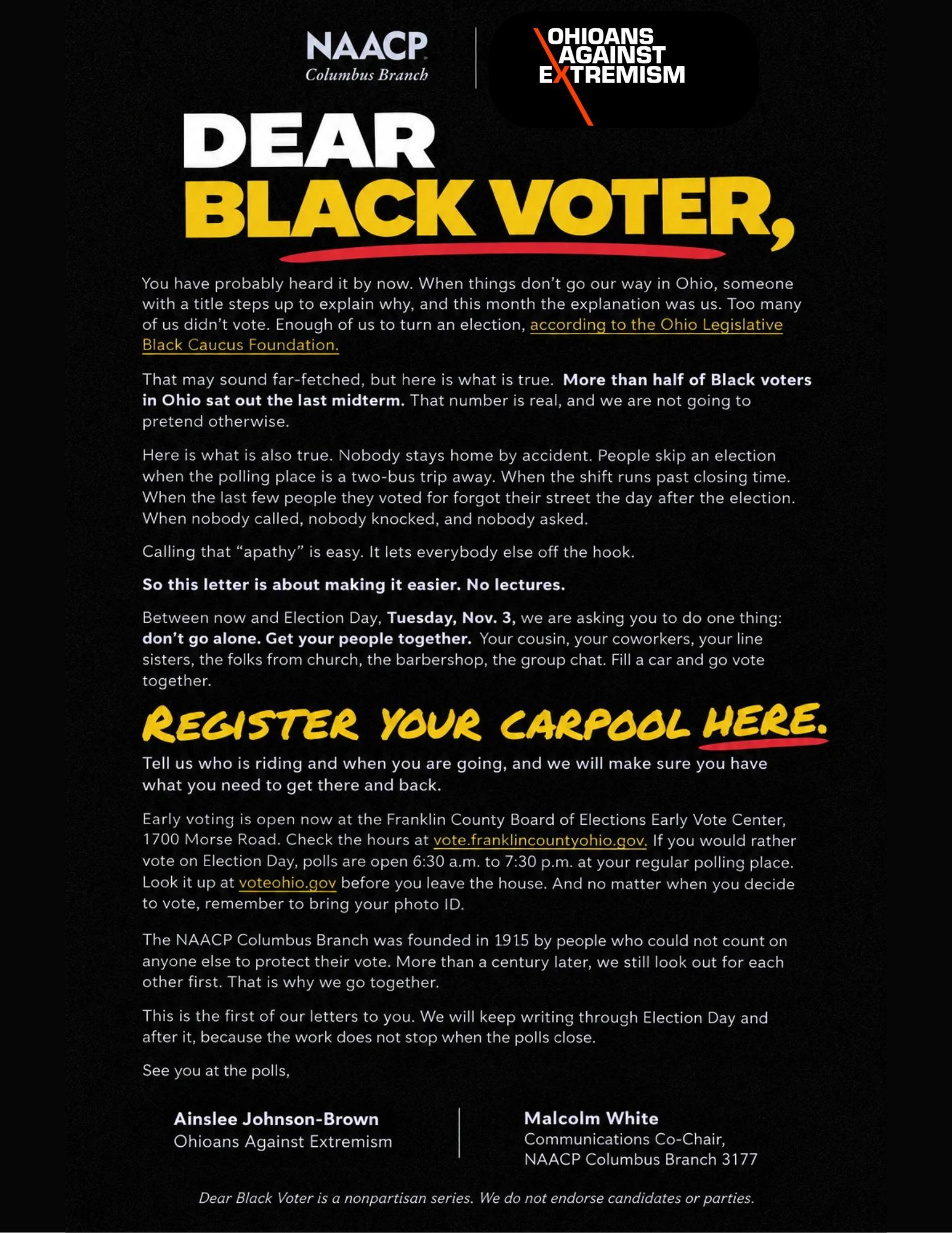
That’s the thinking behind Dear Black Voter, a new nonpartisan letter series I’m launching alongside Malcolm White, Communications Co-Chair of the NAACP Columbus Branch.
We want to have the conversations that too often get replaced by turnout statistics and political strategy. We want to acknowledge the real obstacles to participation without pretending Black voters lack the capacity to understand what’s at stake.
And we want to offer something practical.
Our first letter asks Black voters to do one simple thing this election: Don’t go alone. Get your people together.
Because if we’re going to keep telling Ohioans that fighting extremism starts with talking to the people closest to them, we should be willing to demonstrate what that looks like.
This is our first letter, but the conversation won’t end on November 3.
I hope you’ll read it, share it, and think about how we can build political participation that survives long after the campaign signs come down.
Ainslee Johnson-Brown, J.D.
Co-founder, Ohioans Against Extremism
Help us Protect Ohio’s Election and Make a Plan to Vote!
How to research your ballot and get more involved in protecting Ohio’s election.

Support & Follow Ohioans Against Extremism
If you appreciate our work, please consider supporting our work. We don’t paywall, and we don’t have any billionaire friends :(